Now I order you to retain this creed for your nourishment throughout life and never to accept any alternative, not even if I myself were to change and say something contrary to what I am now teaching, not even if some angel of contradiction, changed into an angel of light, tried to lead you astray. For even if we, or an angel from heaven, should preach to you a gospel contrary to that which you have now received, let him be accursed in your sight. – St Cyril of Jerusalem
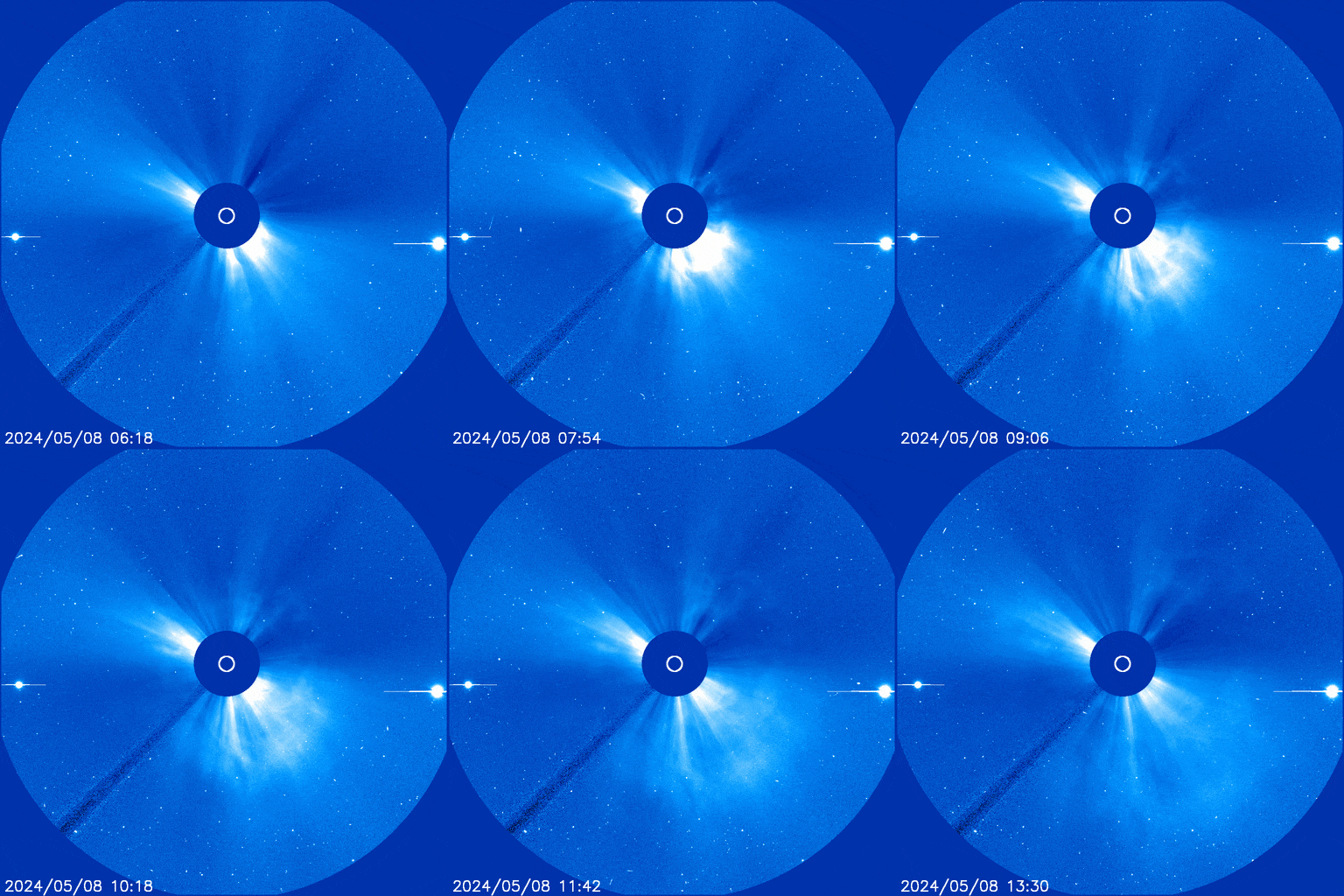
THE CME HAS ARRIVED: Arriving hours earlier than expected, a CME struck Earth’s magnetic field on May 10th at 1645 UT. The big impact sparked a severe (G4) geomagnetic storm–ongoing now. More CMEs are following close behind, and their arrival could extend the storm into the weekend. Follow this developing story @ Spaceweather.com.
CME impact alerts: Sign up for Space Weather Alerts to receive instant text messages when CMEs hit Earth.
Above: The source of today’s CME, giant sunspot AR3664 photographed at sunset between two eucalyptus trees by Marco Meniero of Civitavecchia, Italy
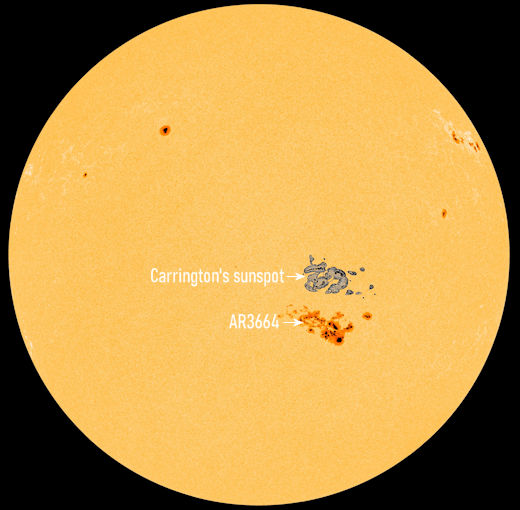
HUGE SUNSPOT HURLS CME TOWARD EARTH: A sunspot so large it visually rivals Carrington’s famous sunspot of 1859 hurled a CME toward Earth today. Don’t worry! A new Carrington Event is not in the offing. The incoming CME isn’t potent enough. However, this huge sunspot merits watching while Earth is in its strike zone. Full story @ Spaceweather.com.
CME impact alerts: Sign up for Space Weather Alerts to receive an instant text message when the CME arrives.
‘The Sunday Eucharist is the foundation and confirmation of all Christian practice. … Those who deliberately fail in this obligation commit a grave sin.’ (CCC 2181)
I just read a jarring statistic that 72% of self-identified Catholics in the United States do not attend Mass every week.
That fact was reported in an April 12 “short read” from the Pew Research Center, “9 Facts About U.S. Catholics.” The article, based on data originally reported in 2018, summarizes other facts disclosed in the PEW Center’s National Public Opinion Reference Surveys (NPORS) and through the Center’s American Trends Panel regarding Catholics’ racial and ethnic distribution, educational background and support for Pope Francis.
But back to that shocking finding: Only 28% of Catholics attend Mass at least weekly, even though the Catholic Church clearly teaches that missing Sunday Mass (except for a good reason, such as illness or inability to get to a nearby parish) is a mortal sin.
To my way of thinking, the logic is straightforward:
The 72% of self-described Catholics who don’t attend the Sunday liturgy each week either don’t really believe in God, or they don’t think that belief in God warrants their attention every week.
The Church, of course, thinks otherwise — declaring it a mortal sin to miss Mass on a Sunday without a just reason.
So there is a reason to attend Mass: because it’s obligatory, and missing Mass endangers the soul.
But there is a better reason to attend, and not simply to fulfill an obligation. The mature Catholic (that is, the thoughtful Catholic who has considered arguments for the existence of God, and who appreciates the power and the presence of God in our lives) will choose to attend Mass each week for several reasons:
to worship God who was powerful enough and loving enough to create each of us, and who will someday judge the condition of our souls;
to receive teaching each week;
to receive the Eucharist;
to gradually become more and more like Christ; and
to reach the holiness to which we are called.
A Catholic who does not believe in God needs to do his homework — to read, to study, to pray — to find out that God truly does exist.
And a Catholic who truly believes that God exists, but who chooses to disregard the rules imposed by God’s church, should do his homework to discover what is expected of him as a Catholic, and why. The Catholic Church, speaking with the authority vested by God, calls on Catholics everywhere to keep the Lord’s Day holy in one specific way — by joining with their fellow Catholics around the world in the most perfect worship, the holy Mass.
There are many places in Scripture where God’s conferring of authority upon his Church is evident. In Titus 2:15, for example, God says, “Declare these things; exhort and rebuke with all authority. Let no one disregard you.”
In Matthew 18-20, Jesus gives the Great Commission and promises that he will support his Church until the end of time:
Then Jesus came to them and said, ‘All authority in heaven and on earth has been given to me. Therefore go and make disciples of all nations, baptizing them in the name of the Father and of the Son and of the Holy Spirit, and teaching them to obey everything I have commanded you. And surely I am with you always, to the very end of the age.’
If you are among the majority of Catholics who don’t take seriously the command to worship each week by attending the Sacred Liturgy, please reconsider. Not simply a boring old obligation, the Mass — when prayed with humility and with sincere intent — offers many benefits: You can become holier, taking Jesus himself into your body in Holy Communion, thereby reducing the time you’ll be spending in Purgatory, getting ready for the beatific vision. And your children and loved ones, seeing the love and the happiness that you radiate, will be inspired to grow in holiness themselves.
In the local church, you’ll meet others who share your faith and your hope. These fellow travelers on your earthly journey will become your friends, enriching your life, praying for you, sharing your laughter and your burdens
The Diocese of Scranton will celebrate its annual Mother’s Day Adoption Mass on Sunday, May 12, at 10:00 a.m. at the Cathedral of Saint Peter in Scranton. This liturgy prayerfully recognizes all mothers, with a special emphasis on adoptive and foster mothers. The Most Rev. Joseph C. Bambera, Bishop of Scranton, will serve as principal celebrant and homilist for the Mass. The Mother’s Day Adoption Mass is open to the public and all faithful are invited to attend. CTV: Catholic Television of the Diocese of Scranton will broadcast the Mass live. A livestream will also be provided on the Diocese of Scranton website, YouTube channel and across all Diocesan social media platforms.
May is the Month of Mary – How are YOU planning to honor the Blessed Mother?
Whether it’s planting a Mary garden in your yard (with a mix of roses, marigolds, tulips, lilies, and other blooms to represent Our Lady), placing flowers by her image in your home, or adorning a statue of her with a handmade crown, there are many ways to express devotion to the Blessed Virgin Mary.
EWTN invites you to celebrate along with us, as we honor her throughout the month with special Masses, devotions, and TV specials! Below are a few highlights (for what happens to be Mother’s Day Weekend!), many of which are in honor of Our Lady of Fatima, whose feast day is May 13; see EWTN’s full program schedule in your local time at ewtn.com/tv.
– Friday, May 10 – Forgotten Heritage: Europe and Our Lady – Travel to Ayelsford, England to a Carmelite Shrine where the Blessed Mother is said to have appeared to St. Simon Stock to establish the devotion of the Brown Scapular. Airs at 5:30 p.m. ET.
– Saturday, May 11 – Apparitions at Fatima – Acclaimed for its authenticity, this film faithfully depicts Our Lady’s appearances at Fatima, her message of repentance and devotion to Christ, and the hope she gave to a generation on the brink of war. Airs at 8 p.m. ET.
– Sunday, May 12 – Fatima Candlelight and Rosary Procession – Featuring the praying of the Rosary in multiple languages and a procession with the statue of Our Lady of Fatima. Airs at 8:30 p.m. ET.
– Monday, May 13 – Worldwide Children’s Holy Hour – From the Shrine of the Most Blessed Sacrament in Hanceville, Alabama. Airs at 10 a.m. ET.
– Monday, May 13 – Holy Mass in Honor of Our Lady of Fatima – Includes the blessing of the sick and the famous “Adeus,” white handkerchiefs waving farewell to Our Lady. From the Shrine of Our Lady of Fatima in Portugal. Airs at 5 a.m. ET.
– Monday, May 13 – Holy Mass on the 107th Anniversary of the First Apparition of Our Lady of Fatima – From the National Blue Army Shrine of Our Lady of Fatima in Asbury, New Jersey. The World Apostolate of Fatima brings you this Holy Mass. Airs at 11:30 p.m. ET.
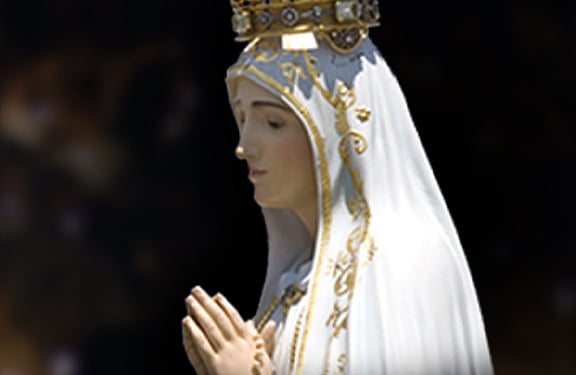
When the Blessed Mother appeared to the three shepherd children in Fatima in 1917, she came with a message of peace and a sobering call to repentance. Let us give thanks for the love she has for us, her spiritual children, and obey her calls for us to pray the Rosary daily, make reparation for sins, and pray for poor sinners.
For more information on Mary, our Mother, plus a free eBook, “Behold Your Mother,” visit ewtn.com/MotheroftheChurch.
VIAChristian Alliance League: God chose Armenia to be the first nation to embrace Christianity and spread it to the world. This happened back in the 4th century A.D. Since then, these Christians have faced tough times, especially from nearby empires.
1. In the year 301 A.D., King Tiridates III made Christianity the official religion of this land. But that didn’t stop persecution. Christians still suffered violence and death.
2. In the following centuries, this Christian country was controlled by enemies who persecuted Christians even more. Many were killed for sticking to their faith in Christ.
3. In 1915, the Ottoman Turks committed the Armenian Genocide. Around 1.5 million Christians were dead, and many others were forced out of their homes.
4. More recently, in Artsakh, over 120,000 Christians were ethnically cleansed their homes after a 9 month blockade.
Despite all this suffering, these Christians stayed strong in their faith. Their resilience shows Christianity’s ability to survive and thrive, even in tough times. They still face attacks today, especially in places like Tavush, from Turkey and Azerbaijan. As Christians, we should support them in their fight for their faith and their homeland..
Refugees load a truck in Goris on Sept. 26 before leaving to Yerevan.
A continuous stream of vehicles crept along the only road out of Nagorno-Karabakh toward Armenia,
carrying tens of thousands of refugees now faced with an uncertain future.
(photo: ALAIN JOCARD / AFP via Getty Images)
Living in the constant motion of a 24/7 news cycle inevitably pushes certain headlines off the front page. In recent months, that has been the plight of tens of thousands of Armenia refugees flung out of the Nagorno-Karabakh region. In September, neighboring Azerbaijan, an Islamic nation, invaded Armenia and blockaded what Armenians call Artsakh. The region has been a locus of ongoing conflict since the fall of the Soviet Union, but events took a significant turn with the 2023 Azerbaijan offensive.
The result was a massive upheaval for those who call Artsakh home. Since then, fleeing Armenians — the vast majority of whom are Christian — have endured the constant threat of danger and the deprivation that followed.
American diplomat Sam Brownback, a Catholic, called the invasion and offensive a “religious cleansing” against Armenian Christians.
About 90% of the Armenian population as a whole is Christian, according to the U.S. State Department, most of whom are Orthodox, and fewer than 10% Catholic. Armenians proudly call their homeland “the first Christian nation,” referring to King Tiridates III proclaiming Christianity the official religion of the Kingdom of Armenia at the beginning of the fourth century. The Armenian Apostolic Church’s Etchmiadzin Cathedral is frequently cited as the oldest Christian church in the world. Pope Francis visited the historic site in 2016.
When Pope St. John Paul II traveled to Armenia in September 2001 to commemorate the 1,700th anniversary of Christianity in Armenia, he said, “A striking feature of this land are the many crosses in the form of the khachkar, testifying to your steadfast fidelity to the Christian faith.” A khachkar is a specifically Armenian artistic representation of the cross, typically as a free-standing stone monument.
Azerbaijan has routinely led pogroms of destruction against the khachkar over the decades.
POPE FRANCIS: “Your Beatitude, dear Brothers,” Pope Francis said, “how can we not turn our thoughts to Armenia, not only in words but above all in our prayers, particularly for all those fleeing Nagorno-Karabakh and for the many displaced families seeking refuge?”
“The First World War,” he continued, “was supposed to be the last …Yet since then, how many conflicts and massacres have we witnessed, always tragic and always pointless?”
“Let us all take up the cry for peace,” the Pope urged, “so that it may touch hearts, even hearts untouched by the sufferings of the poor and lowly. And above all, let us pray. I pray for you and for Armenia.”
111. Another hermit said, ‘A man ought always to be working at something in his cell. If he is busy with the psalms, the devil comes to him day after day but finds no resting-place there; even if he succeeds in conquering him and taking him prisoner, God’s spirit often comes to him again. But if we are sinners and do not let God’s spirit come to us, he will leave us alone.’
“If you want to be close to Christ, I repeat to you ‘Ite ad Ioseph’: Go to Joseph!” – Pope Ven. Pius XII
Dear Friends,
Today the Church celebrates the feast of St. Joseph the Worker.
While St. Joseph’s primary feast day is March 19th, in 1955 Pope Pius XII added a second day on May 1st, celebrated as the Memorial of St. Joseph the Worker. As a carpenter, St. Joseph worked very hard. His manual labor was difficult, and he is a great example to all of us in our daily work. In addition, he is a powerful intercessor for those who are seeking employment.
How did St. Joseph serve God? What can we learn from St. Joseph? Why is St. Joseph the sleeping saint?
On the page, we also offer a free eBook, Ora et Labora. This eBook encourages you to unite with Christ as you perform daily tasks. It explains what Scripture, the Church, and our friends, the saints, have said about manual labor and its dignity.
We hope this eBook and this page help you strengthen your faith through the intercession of Holy St. Joseph.
May God bless you! In Christ,
Your EWTN Family EWTN 5817 Old Leeds Rd Irondale AL 35210
By following this message their spiritual lives were elevated to the heights of sanctity…
The most important dimension of the Fátima event was not the supernatural and preternatural phenomena but the content and the meaning of the message communicated to the children. By following this message their spiritual lives were elevated to the heights of sanctity, to which the beatification of Jacinta and Francisco testifies, and the hope and possibility of the conversion of the world from its ruinous course was offered to mankind.
This message can be seen as comprising two essential elements, to which all others can be related in some way. The first of these elements is the singular role of the Immaculate One in the economy of salvation, a dogmatic fact. God does not have whims, and so the request of the Almighty that devotion to the Immaculate Heart be established in the world must be founded on reality and presumes that such devotion is justly given to the Mother of God.
The second of these elements involves the practical order, the value of devotion to the Immaculate Heart for the individual life and for the future of the human race. To this element are connected the various spiritual practices encouraged by the Angel and by the Lady, as well as the prophetic content of the message, upon which the fate of the world depends. Without the first element, the dogmatic, the practical dimension of the message of Fátima would be entirely arbitrary.
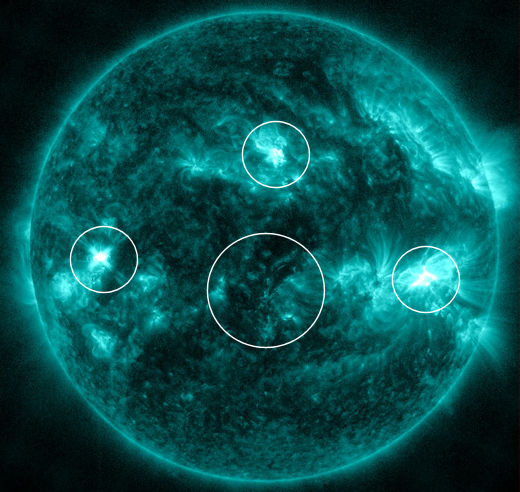
A RARE QUADRUPLE SOLAR FLARE: Sometimes we get excited about a single solar flare. This morning the sun produced four flares in quick succession–an almost simultaneous cascade spanning hundreds of thousands of kilometers. The quadruple explosion is an extreme example of a phenomenon called “sympathetic solar flares.” Full story @ Spaceweather.com.
Solar flare alerts: Sign up for Space Weather Alerts to receive instant text messages when strong solar flares are underway Above: Sympathetic solar flare activity on April 23, 2024. Visit Spaceweather.com to see the movie.
Will any of the debris hit Earth? SOHO coronagraph images of the blast are now available, but the results are unclear Many faint overlapping CMEs can be seen leaving the sun in the hours after the quadruple eruption. If any are heading our way (a big IF), they would arrive on or about April 26th. CME impact alerts:SMS Text







 Deaconjohn1987's Blog